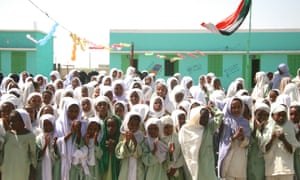
Balad Al-Nabi Hamad, nine, left school after a household accident.
“I was at home on sick leave but I wasn’t sure when I’d be going back. Then I started hearing from the girls in my village that our school had become so beautiful and I decided to finish the school year,” says Balad.
The school had received a grant from the UN children’s agency, Unicef, for improvements, which prompted the board of education, the local council and families in the area to raise 20,000 SDG (around £2,300) and implement extensive plans to expand and renovate Um Al-Gura girls school, Nahr Atbara, Kassala state. The school currently has 605 girls enrolled.
Two-thirds of world's illiterate adults are women, report finds
Read more
“I have 101 girls registering for first grade next academic year but I can only accept 50 students,” says principal Iman Hassan.
Sudan has one of the highest rates of out-of-school children in the entire Middle East and North Africa (Mena) region, with more than 3 million children aged from five to 13 not enrolled. More than half of those out of school are girls, mostly from rural areas where the female literacy rate is as low as 39% (pdf) and primary school completion is only 26.1%, according to Unicef.
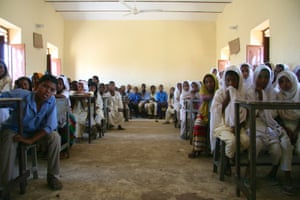
Traditional beliefs that emphasise the role of girls in the household and condone early marriage have meant that many parents take their daughters out of school as they approach puberty.
Yet NGO grants, effective planning from local authorities and national enrolment campaigns are beginning to shift attitudes and boost attendance numbers. In some rural areas, girls are taking exams to enter secondary school for the first time and many who had left school are now returning.
Word of mouth is also playing a part, as girls spread stories of their newly renovated schools to their peers and encourage out-of-school children to return.
“I left school because it was far from my home and it wasn’t so pretty. It didn’t have bathrooms or games or drawings on the walls. But my friends came and told me about all the new things in the school and I decided to come back – I loved it and a lot of the girls in my village came back with me,” says Inshira’h, a third grader (the equivalent of year 4 in the UK) from the Fidiaeb girls school.
Inshira’h lives in a village outside Kassala town, in the suburb of Fidiaeb. The school’s headteacher, Iman Bakri, says she has to convince the girls to leave the grounds at the end of the school day.
Read more here

No comments:
Post a Comment